Quick Read:
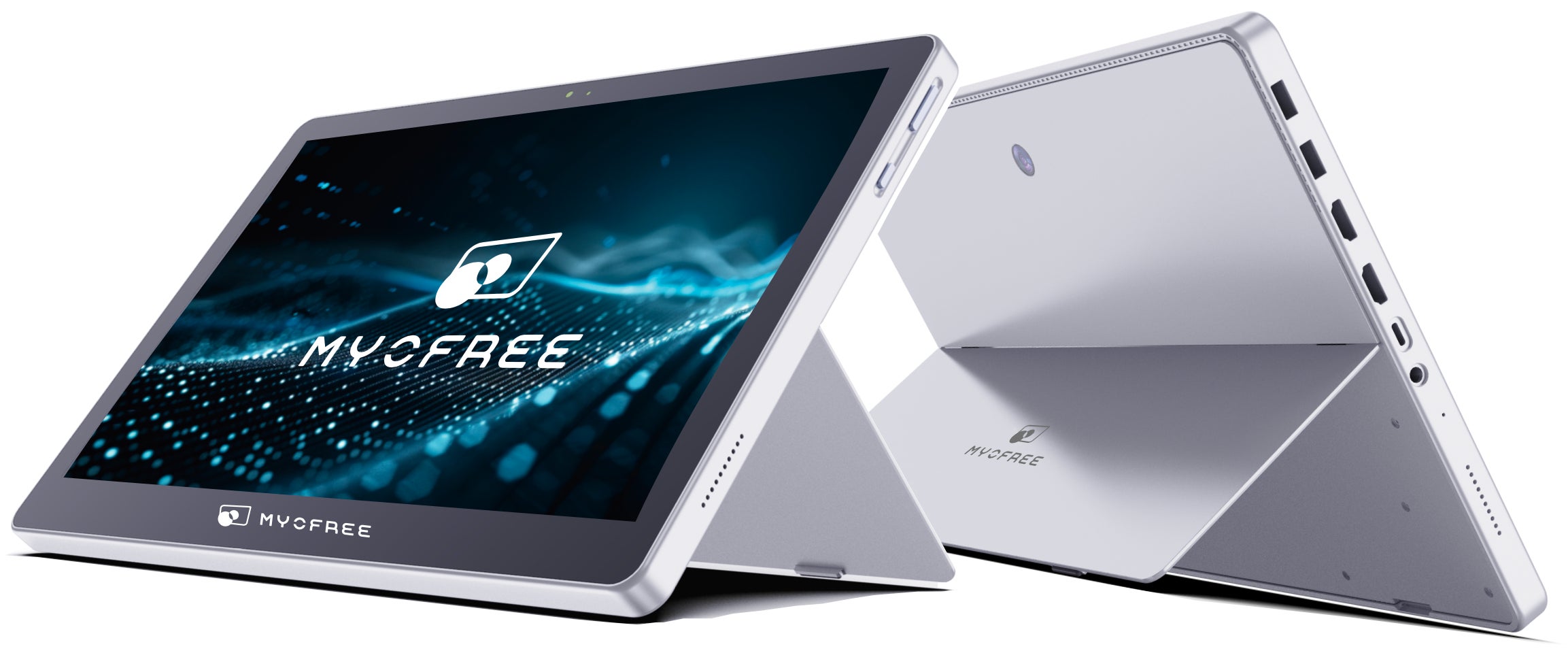
- The Myofree is a 15.6-inch Android tablet from Kyodo, an 87-year-old Japanese parts maker, with pre-orders on the crowdfunding site Makuake from November 18, 2026.
- Its eye-comfort trick works only with special polarized glasses: they're designed to make your eyes point as though the screen were roughly 12.5 times farther away than it is — about 5 metres instead of the 40 cm the screen actually sits from your face.
- The eye-posture shift has been measured — but only in measurements the company itself describes, and they measured where your eyes point, not eye strain.
- No published study of the finished product was found in the literature checked; the company's own materials call the benefit an expectation and say it's not a medical device.
- An August 2026 partner release put the estimated price at ¥260,000, but the final crowdfunding price is unknown, and so are the shipping date and availability outside Japan.
- The company's own usage guidance is strict: not recommended under age 7, ages 7–13 only with a guardian supervising, short 5–15 minute sessions, and a 10-minute break every 30 minutes.
The quick version
A Japanese company you've probably never heard of is selling a tablet with an unusual idea baked in: put on the special glasses, and the screen you're holding 40 cm from your face starts behaving, for your eyes, like something sitting 5 metres away.
That's the pitch behind the Myofree, a 15.6-inch Android tablet from Kyodo — an industrial parts maker founded in 1939, not the Japanese news agency with a similar name. Pre-orders open on November 18, 2026 on Makuake, a Japanese crowdfunding site, which is a bit like Kickstarter.
The idea is genuinely novel. Whether it actually delivers the eye comfort it promises is, so far, unproven — and the company itself says so.
How the trick works
When you look at something close up — a phone, a book, a tablet — your eyes do two things at once. They point inward toward it, and they focus on it. Point and focus are supposed to match.
The Myofree splits those two jobs apart. The tablet rapidly flashes slightly different images to your left and right eye — the company describes generating 120 images per second for each side — and the tablet's dedicated circularly polarized glasses act like a gatekeeper, letting each eye see only its own image. Circular polarization lets two images share one screen by giving each a different 'spin'.
With each eye seeing a shifted image, your eyes naturally point at a spot well behind the screen — close to how they'd point if you were looking at something about 5 metres away. The screen is meant to be 40 cm from your face. That's a 12.5-to-1 gap between where the screen physically is and where your eyes are pointing — the whole product is built around that one number. Kyodo calls the goal reducing 'visual environment stress'.
One button switches the effect off, back to a normal tablet. There's also an HDMI input, so it can double as a second screen for a laptop.
What's actually been shown
Here's the distinction the marketing tends to blur, and it matters.
The company describes a measurement, done in November 2025 by an eye-tracking specialist firm using its EMR-10 gaze tracker, comparing three setups: a normal screen up close, the same screen in Myofree mode, and a real monitor 5 metres away. In Myofree mode, people's eyes pointed behind the screen, close to the 5-metre pattern. So the mechanism — the posture change — appears to work as described.
But that measurement captured where the eyes point. It did not measure eye strain. Those are different things, and nothing in the available evidence connects the posture change to actually feeling less strain.
The only independent hands-on found is a single writer's short demo at the CEATEC electronics show in October 2026. Without the glasses, the image looks doubled. With them, the image seems to float well behind the screen — like watching 3D TV in reverse. You have to sit facing the screen head-on. The writer's verdict was hedged: it did feel somewhat easier on the eyes, though the effect might only become clear over long use.
An ophthalmologist — an eye doctor, Hidehisa Onda of Showa Medical University — is quoted in the company's materials. Read his quote carefully, though: he calls the idea novel and says it could become a new eye-care option if it reduces visual load up close. That's a conditional hope, not an endorsement that it works. Kyodo's own product page headline goes further, saying the device is 'recommended by an ophthalmologist' — no second doctor's quote appears anywhere.
Kyodo says it plans joint research with Showa Medical University to verify effects objectively. Which is another way of saying: that verification doesn't exist yet.
What the science around it says
The vision-science literature on nearby screens is messier than the marketing implies — and some of it cuts against the assumption behind this product.
One published review found that people's screen-related symptoms tracked underlying eye and vision disorders, not how long they spent looking at screens (MDPI). Another found mixed and sometimes null results on whether close-up work changes eye-pointing behaviour at all (BMJ Open Ophthalmology). One study measured no meaningful change in eye-focusing or eye-pointing after 30 minutes of smartphone use — a null result on essentially the pathway this device targets (Dove). And on the children's-eyesight angle, the large reviews describe the links between close-up work, screen time and myopia (short-sightedness) as weak and inconsistent; the best-evidenced protective factor for children's eyes is time spent outdoors.
None of this proves the Myofree doesn't help. But it does mean you shouldn't assume it does.
There's also a wrinkle the company doesn't address. Stereo-display research has a name for the mismatch between where your eyes point and what they focus on: the vergence-accommodation conflict. It's a defined, studied phenomenon — but whether this particular mismatch, in this direction and magnitude, causes discomfort or relief in normal use is unknown; no published answer was found in the literature checked.
The company's own guardrails hint at caution. According to an August 2026 release from a trial partner, the guidance is: not recommended under age 7, ages 7–13 only with a guardian supervising, sessions of 5–15 minutes, a 10-minute break every 30 minutes, and no long continuous use. The strictness is at least worth noticing.
The 'world's first' claim, with its fine print
Kyodo calls the Myofree the world's first of its kind. That's footnoted as the company's own survey, and the scope is narrower than the headline: it means the first integrated tablet that can display any content — video, websites, anything — in this parallel-view state, as of October 2026. It's a company claim, not an independently audited one.
What about the price?
This is where the story gets genuinely uncomfortable for a would-be buyer.
An August 2026 press release from a restaurant-chain partner running a free-trial campaign put the estimated price at ¥260,000 for a device weighing 2.6 kg. If the crowdfunding presale really is limited to 100 units at promotional pricing, that first tranche would be worth up to about ¥26 million in total at that estimated price. But the final Makuake pricing hasn't been published: the live campaign page doesn't show its reward tiers in what was checked, and the ¥260,000 figure is a months-old estimate, not a confirmed price.
The shipping schedule? Undisclosed. Availability outside Japan? Unconfirmed.
So the practical situation is: a possibly very expensive device, whose benefit is unproven, available on pre-order with no ship date and no confirmed retail price. That's not disqualifying — crowdfunding works this way — but anyone reaching for a credit card on November 18 should know exactly what they're buying.
Who's actually bought in so far
Kyodo reports that over 1,500 people tried the device across four days at CEATEC 2026, with over 90% saying they felt depth or immersion. A cumulative count across five events and locations — note that word: cumulative, so the same person visiting twice counts twice — reached 2,634 survey participants, over 90% answering 'good'. Trial installations include a city library, a university library, schools, a clinic waiting room and a BMW showroom, according to the company.
Take the enthusiasm seriously as enthusiasm — and no more. Kyodo itself disclaims all of it: these are subjective impressions, not evidence of any physical or medical effect.
Not a medical device
One more thing worth stating plainly, because the 'eye-care tablet' framing invites optimism: under Japanese law, neither the tablet nor its glasses is a medical device. The company's own disclaimer says the product is not intended to diagnose, treat or prevent any disease, guarantees no specific effect, and that experiences vary. If you're a parent wondering whether this will protect your child's eyesight — the product makes no such claim, and no evidence in the literature checked supports it.
A useful comparison: TCL's NXTPAPER screens also use circular polarization for eye comfort, but the mechanism is completely different — TCL's hardware changes the character of the light to feel more paper-like, with no glasses, and doesn't touch where your eyes point. Also, if you see the TCL NXTPAPER 14 Pro described as a CES 2024 award winner: TCL's own release says that award went to its 40 NXTPAPER phone, not the tablet.
How this was reported
- Strongest primary sources: Kyodo's launch release on PR TIMES (https://prtimes.jp/main/html/rd/p/000000003.000190470.html), Kyodo's own product and history pages (https://www.kyodo-rubber.co.jp/en/products/in_house/myofree/; https://www.kyodo-rubber.co.jp/about/history/), the live Makuake campaign page (https://www.makuake.com/project/myofree/), Kyodo's 2024 eye-tracking news release (https://www.kyodo-rubber.co.jp/newsrelease/1713144044/), TCL's NXTPAPER 3.0 press release (https://us.tcl.com/blogs/press-releases/tcl-celebrates-winning-ces-2024-innovation-award-for-tcl-nxtpaper-device-and-introduces-advanced-tcl-nxtpaper-3-0-technology), and the August 2026 partner release carrying the estimated price and usage guardrails (https://prtimes.jp/main/html/rd/p/000001645.000001511.html)
- Important independent sources: Gizmodo Japan's hands-on at CEATEC 2026 (https://www.gizmodo.jp/article/myofree/), Notebookcheck's careful English summary (https://www.notebookcheck.net/Myofree-eye-care-tablet-uses-special-glasses-to-change-how-users-view-its-15-6-inch-screen.1450246.0.html), GetNews's development-history feature (https://getnews.jp/archives/3754787), and the peer-reviewed vision-science reviews linked in the science section
- Major unresolved facts: final Makuake pricing, shipping schedule, international availability, whether the benefit holds up in an outcome study, whether the vergence-accommodation mismatch causes discomfort for some users, and whether 'recommended by an ophthalmologist' reflects more than one conditional expert quote
- Corrections and contact: Spotted an error? Email contact@bulletnews.com and we'll fix it.