Huawei’s claim is important — but not proven
Huawei rotating chairman Eric Xu says Ascend has surpassed Nvidia in China’s market for AI accelerators, the chips used to train and run AI models.
But the claim has a large hole. Huawei hasn’t said whether “market share” means chips shipped, sales revenue, installed computing power or something else. It also hasn’t named the measurement period or published the figures behind its conclusion.
Independent reporting confirms that Nvidia’s exact share in China is difficult to determine. None of the available sources offers a direct, independently verified comparison between Nvidia and Huawei for 2026.
The historical evidence adds context. An IDC overview from the first half of 2024 described Nvidia as China’s dominant accelerator vendor overall, while Huawei led the part of the market not served by Nvidia. That snapshot is too old to disprove Huawei’s September 2026 statement. It does, however, show why a reversal shouldn’t be treated as established without current figures.
The defensible conclusion is narrower: Huawei says Ascend has moved ahead in China, but the public evidence doesn’t establish that as fact.
The specifications show a mixed picture
A specifications-based analysis compared Huawei’s Ascend 950DT with Nvidia’s H200. Memory was the closer contest. The analysis estimated that the 950DT offered about 83% of the H200’s memory bandwidth and 87% of its local-link bandwidth, which measures how quickly data can move through nearby connections.
The computing-power estimates were lower. For BF16 and FP8 — two ways AI chips represent numbers while doing calculations — the 950DT reached an estimated 43% and 41% of the H200’s theoretical throughput, respectively.
The gap was wider against Nvidia’s B300. In the Atlas 650E setup examined, the 950DT had less than one-fifth of the B300’s theoretical computing power, around half its memory bandwidth and roughly one-third its memory capacity.
These are comparisons of specifications, not results from identical AI jobs. The available evidence contains no standardized benchmark directly comparing Ascend 950DT systems with H200 or B300 systems under the same conditions. Broad measurements of reliability, software maturity and everyday operating performance are also missing.
Huawei is building enormous systems around Ascend
Huawei’s strategy goes beyond the performance of a single chip. It is connecting large numbers of Ascend processors so they can work together on one computing job.
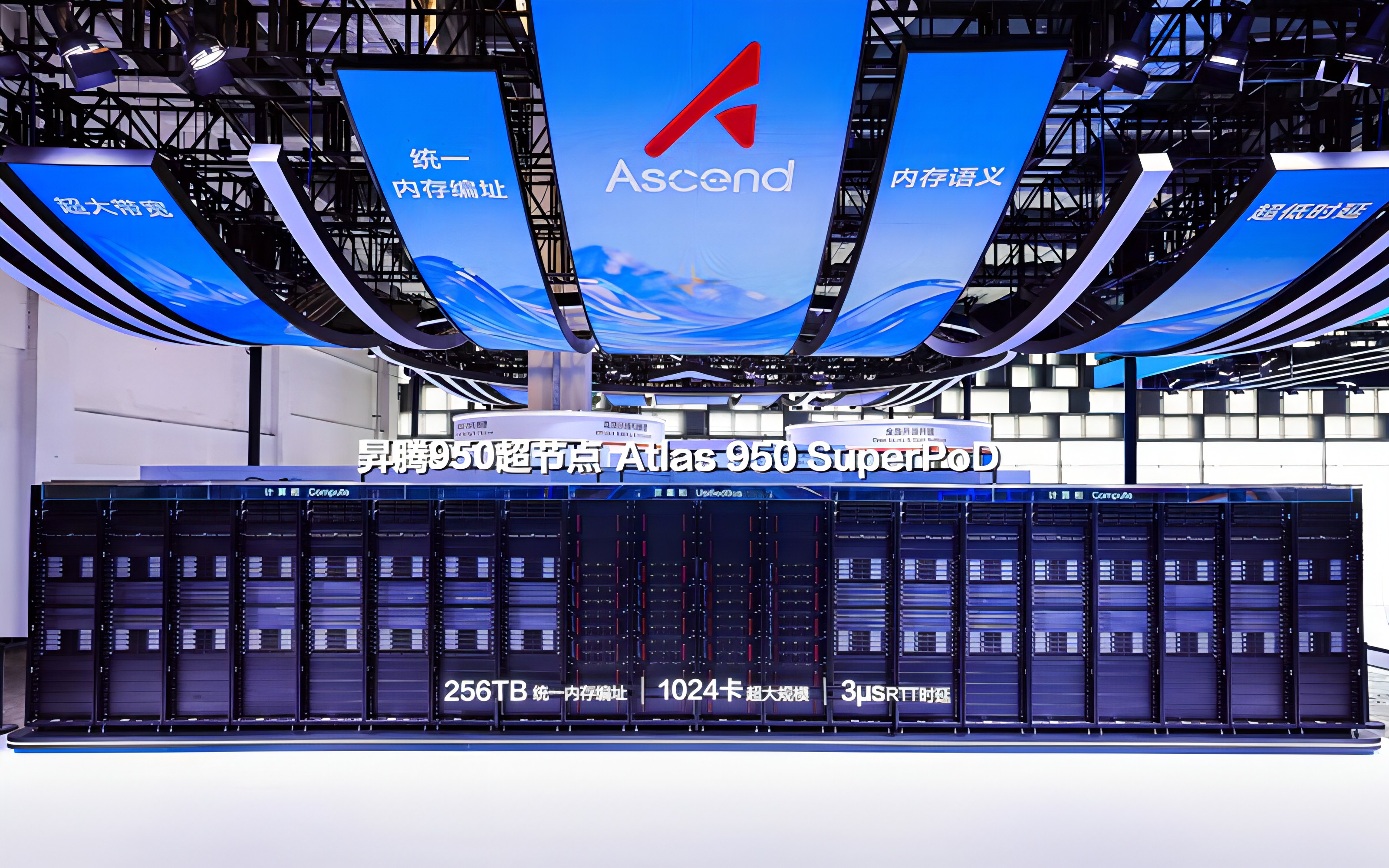
The company calls this architecture Peerium. Huawei says it combines ways to divide work, organize memory and link processors, allowing as many as one million processors to operate as one computer.
UnifiedBus connects the system’s processors, memory, storage and networking equipment, much like roads joining different parts of a city. Huawei says the technology uses an open protocol.
Huawei also says it is deploying and testing an Atlas 950 SuperCluster containing about 256,000 computing cards. That figure cannot be directly compared with Peerium’s one-million-processor claim. One counts cards and the other counts processors, while the number of processors on each card isn’t given.
The deployment shows that Huawei is building a very large system. It doesn’t reveal how efficiently that system performs in routine use.
Export controls and supply limits constrain both companies
Nvidia’s financial disclosures show how sharply US export controls affected its China-focused H20 product. After the US government required export licences for H20 chips and comparable products in April 2025, Nvidia recorded a $4.5 billion charge tied to excess inventory and purchase commitments.
Nvidia later received licences for some H20 shipments to customers in China and reported about $60 million in revenue from those sales. The earlier charge was 75 times that revenue figure.
That isn’t a profit comparison: one figure is an inventory-related charge, while the other is revenue. The ratio instead shows how small the later licensed sales were beside the earlier charge.
Huawei faces a different immediate problem. Xu said the Ascend 950PR, mainly intended to run trained AI models, was available only in relatively small quantities. Systems based on the training-focused 950DT were still being tested, with large-scale supply expected around the end of 2026 or early 2027.
Huawei says it cannot make enough Ascend equipment to meet demand in China. TrendForce reported Xu’s statement that Huawei is selling all the accelerators it can produce, but no independently audited production or backlog figures are available. Separate analysis points to limits in advanced domestic chip manufacturing.
Huawei says these shortages are keeping its attention on China. It is supplying small test quantities in a few overseas markets but has no plan for a full international rollout while Chinese demand remains unmet.
US regulation also affects Ascend. Legal alerts describing US export-control guidance say certain Ascend chips are explicitly named and warn that using, selling, financing or servicing them can create compliance risks under US rules. Export controls haven’t simply constrained Nvidia while leaving Huawei free of regulatory pressure.
The size of the broader Ascend backlog, typical delivery times and Huawei’s method for allocating scarce systems remain unknown.
Market share and performance are different questions
Nvidia’s H20 business was materially affected by export restrictions. Huawei, meanwhile, reports demand beyond its production capacity and says it is deploying a 256,000-card cluster.
Those facts are consistent with Huawei becoming a more important supplier in China. They don’t establish that it has taken the overall market lead.
Current figures using a clearly defined measure would be needed to test Huawei’s market-share claim. Standardized benchmarks would answer a separate question: how Ascend systems perform against Nvidia hardware when running comparable work.
Huawei hasn’t published the market data, and the available sources don’t provide standardized system comparisons.
How this was reported
- Strongest primary sources: Huawei’s Peerium architecture announcement and Atlas system announcement establish its architecture and deployment statements.
- Important independent sources: Reuters, TrendForce and an independent specifications analysis added market, supply and hardware context.
- Major unresolved facts: Huawei hasn’t disclosed the measure or figures behind its market-share claim. Standardized system comparisons, typical delivery delays and broad reliability data for Peerium systems remain unavailable.
- Corrections and contact: Please send correction requests and other messages to the BulletNews desk. Published: 2026-10-08 · Last updated: 2026-10-08.